
NOTE: This article is the 3rd part in a four-part series on cognitive biases in business decision-making that emerged from an interactive, hands-on internal workshop led by Benjamin Kardum (Senior Project Manager) and Ana Schauperl (People and Culture Specialist). The workshop brought together cross-functional teams to explore how cognitive biases influence everyday decision-making in real-world business and project environments.
Availability bias (also known as the availability heuristic) is a cognitive shortcut that leads people to judge how common, important or likely something is based on how easily they can recall examples of it.
In the context of business decision-making, availability bias causes leaders to overweight information that is recent, vivid, emotionally charged, or highly visible — while underweighting slower-moving, less visible but statistically more important data.
Our brains are naturally wired to prioritise:
- recent events
- emotionally intense stories
- dramatic or high-profile incidents
- highly memorable experiences
As a result, quieter but more statistically meaningful information often fades into the background.
This is why a single viral layoff story can suddenly make an entire industry feel unstable, or one high-profile cyberattack can trigger sweeping security decisions, even if overall risk levels have not meaningfully changed.
What feels most “available” in memory is often mistaken for what is most important in reality.
Availability bias does not distort facts — it distorts attention.
And once attention is distorted, decision-making inevitably follows.
Image 1: Availability heuristic
“If you can think of it, it must be important”
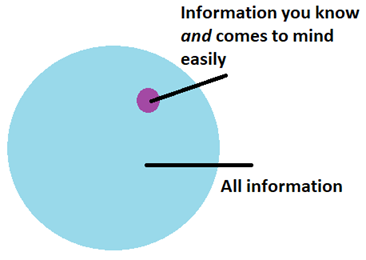
Source: https://statisticsbyjim.com/basics/availability-heuristic/
How availability bias shapes business decision-making
In organisations, availability bias in business decision-making quietly reshapes priorities by shifting focus from structural, long-term signals to recent, highly visible events.
Leaders may overreact to:
- the last complaint they heard
- the most recent headline in the news
- a single vivid anecdote from a key client
- a recent internal incident or failure
As a result, strategic focus moves away from sustainable performance drivers and toward whatever feels most urgent in the moment.
One of the most common expressions of this bias is the tendency to treat the recent past as a reliable guide to the future.
Availability bias leads leaders to overvalue recent, vivid or emotional events, creating false urgency and distorting strategic priorities away from long-term signals.
Recency over trends
When making forecasts, managers often place far more weight on what happened most recently than on long-term patterns.
The latest quarter, last campaign, or most recent crisis feels more “real” than years of historical data — even when the broader dataset is far more representative.
This is a direct expression of availability bias in business decision-making, where cognitive accessibility replaces statistical reasoning.
High-profile events and distorted risk perception
Rare but dramatic events often dominate corporate risk perception far beyond their actual probability.
After a highly public cyberattack or a major competitor failure, executives may behave as if the same event is imminent within their own organisation.
This typically results in:
- sudden budget reallocations
- urgency spikes driven by fear
- overinvestment in visible risks
- underinvestment in less visible but more probable risks
In startups, the same effect appears when one funding success story inflates expectations while hundreds of average outcomes are ignored.
A vivid narrative always feels more convincing than long-term probability data — even when it is statistically irrelevant.
Sharks vs coconuts: a classic availability bias example
A widely cited example of availability bias is the comparison between shark attacks and falling coconuts.
Sharks dominate public perception due to media coverage, films, and cultural storytelling. However, they cause only around 10 deaths per year globally.
Falling coconuts, by contrast, are estimated to cause approximately 150 deaths annually.
Despite this, most people intuitively perceive sharks as the greater threat because dramatic, emotionally charged events are more easily recalled.
This illustrates a core principle of availability bias:
what is easiest to remember is often mistaken for what is most likely.
Countering availability bias in decision-making
Reducing the impact of availability bias in business decision-making requires deliberately changing how information is collected, interpreted, and weighted.
Look beyond recent data
Avoid relying only on recent events when making decisions.
Instead, actively incorporate:
- 5–10 year historical trends
- long-term performance cycles
- multiple economic or market conditions
This helps counter recency-driven distortions created by availability bias.
Broaden information input
One of the strongest ways to reduce availability bias is to expand the diversity of inputs.
This includes:
- cross-functional perspectives
- regional or market differences
- external stakeholders or advisors
A broader information base reduces overreliance on whatever is most mentally accessible.
Question the emotional weight of information
Before reacting to any high-impact or dramatic event, pause and ask:
Is this truly representative, or simply more memorable?
This simple question helps separate emotional salience from statistical significance — a core challenge in managing availability bias.
Replace intuition with structured thinking
Structured decision-making frameworks reduce the influence of cognitive bias in business decision-making, including availability bias.
Examples include:
- structured risk assessments
- multi-source validation
- decisions evaluated across multiple time horizons
- predefined decision criteria
This ensures that isolated, vivid events do not disproportionately influence outcomes.
Slow down decision-making
Availability bias is driven by fast, intuitive thinking (System 1).
Slowing down decision-making activates more analytical reasoning (System 2), allowing leaders to evaluate evidence rather than react to memory strength.
Even small pauses can significantly reduce bias-driven errors.
In essence: why availability bias matters
Availability bias is not just a psychological concept — it is a structural influence on how organisations prioritise, allocate resources, and assess risk.
It shapes:
- what leaders notice
- what feels urgent
- what gets funded
- what gets ignored
By actively counteracting availability bias through broader input, structured thinking, and slower decision-making, organisations move toward bias-aware leadership.
This leads to decisions grounded in evidence rather than visibility — and ultimately, more resilient long-term strategy,

