
Framing Effect: the persuasive power (of how choices are presented)
The framing effect presents cognitive bias in which people’s decisions change not because the facts change but because the presentation of those facts changes [1]. The very same information can trigger entirely different reactions depending on whether it is framed as a potential gain or a potential loss. Although the underlying outcome remains objectively identical, our perception of its value shifts with the wording, context and emotional tone used to describe it. When attention is drawn to what can be won, options tend to feel safer and more attractive, when emphasis is placed on what could be lost, the very same choices suddenly appear risky or threatening.
Framing bias in business occurs when decisions change based on how information is presented rather than the underlying facts. Leaders may choose different strategies depending on whether outcomes are framed as gains or losses. Recognizing this bias helps improve strategic thinking, reduce emotional influence, and support more consistent, evidence-based decision-making.
Image 2 Same facts – different decisions
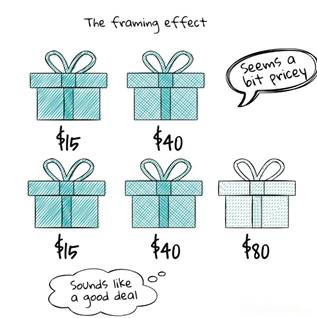
Source: https://rebelsguidetopm.com/the-impact-of-framing-in-decision-making/
We like to think we’re rational, but countless studies show that the words and context used to frame a decision can steer our choices. Business leaders can be just as vulnerable to framing, especially in high-pressure scenarios:
- Strategic decisions – Gain vs. Loss Framing: imagine a company crisis with two restructuring plans: Plan A will “save 200 jobs” out of 600, whereas Plan B has a risky chance to save all or none. Alternatively, describe Plan A as “400 jobs will be lost” out of 600 (the same scenario phrased in terms of losses). Experiments show dramatically different group preferences between these framings. When phrased as lives or jobs saved (a gain frame), decision-makers tend to become risk-averse and favor the sure-save option (Plan A). But when the identical outcome is phrased as lives or jobs lost (a loss frame), people become risk-seeking, often preferring the gambit of Plan B to avoid a certain loss. In real companies, executives may greenlight a project when it’s pitched as “95% chance of success” but reject the same project described as “5% chance of failure.” The content is the same, the emotional impact is not.
- Marketing and customer perception: framing is a well-known tool in marketing. A product labeled “90% fat-free” is more appealing than one stating “contains 10% fat” though they’re identical. Likewise, customers react differently to a fee described as a “small $5 fee” vs. a “5% surcharge”, the way the cost is framed influences their behavior without changing the facts. In one illustration, consumers said they’d rather buy disinfectant wipes “that kill 95% of germs” than wipes where “5% of germs survive” even though 95% efficacy means exactly 5% survive. In a medical context, patients are more willing to undergo a surgery with “90% survival rate” than one with “10% mortality rate”, despite them being the same odds. In each case, framing changes the perceived risk or benefit.
- Employee communications and policy: how management proposals are framed to employees can sway buy-in. For instance, announcing a new policy as “ensuring 99% uptime” will land better than saying it “allows up to 1% downtime”. A cost-cutting initiative framed as “securing our financial health” may gain more support than one framed as “we must reduce budgets by 10%,” which sounds like a loss. Leaders often inadvertently bias the response by the frame they choose to emphasize.
Framing works by tapping into our emotional and psychological reference points, we typically fear losses more than we value equivalent gains (“loss aversion”), so a negative frame hits harder. We also take mental shortcuts based on wording: certain words trigger positive or negative associations that influence judgment beyond the raw data.
Escaping the Framing trap
Escaping the trap begins with one disciplined habit, learning to spot the frame before we accept the picture it paints. As workshop takeaway put it, knowing about the framing effect makes us more vigilant decision-makers. Beyond awareness, the practical technique is reframing:
- Deliberately rephrase the problem: whenever you’re given information or a choice, try to state it in the opposite way and see if your preference changes. If an option is presented in positive terms (gains), reframe it in terms of what you stand to lose, and vice versa. Ask, “If this were described in the opposite (positive vs. negative) way, would I still make the same choice?”. This mental exercise forces you to evaluate the substance of the decision rather than the spin.
- Seek neutral wording and objective data: when possible, look for descriptions that avoid loaded terms. In internal discussions, try to ensure that proposals are described in multiple ways, for example, both the upside and downside perspectives. Rather than relying on “90% chance of success” also consider “10% chance of failure” in your risk analysis, so both frames are acknowledged. If you find your reaction differs, dig into why.
- Use structured decision criteria: create a decision matrix or list of factors that doesn’t rely on any single phrasing. This can anchor the team on facts. For instance, in the layoff scenario, list out the expected outcomes of each plan in raw numbers (e.g. “200 jobs remain, 400 cut” for Plan A) without value-laden words like “save” or “loss” to see the equivalence.
Ultimately, guarding against framing bias means building the habit of looking at decisions from multiple angles. By “flipping the frame” and considering alternate presentations, you immunize yourself against being unduly influenced by marketing spin, clever wording or one-sided storytelling. This leads to choices based on core facts and values, not on cosmetic semantics.
Conclusion: building a bias-aware culture for smarter organizations
Cognitive biases are an ever-present part of human decision-making, but they need not derail your business. By shining a light on anchoring, survivorship, availability and framing biases (that were covered in this two part series article), leaders send a clear message: we won’t make decisions on autopilot. They turn to challenging assumptions, seek out what they are not seeing and make the invisible visible. Organizations that embrace this bias-aware approach build a culture of curiosity and continuous learning, one where tough questions are welcomed and decisions are based on reality, not rosy stories or gut feel alone.
By implementing the practices discussed (and continuously updating them as we learn), you lay the foundation for what one might call “decision-making excellence”. In such a culture, big choices are not hurried reactions but well-calibrated moves that combine the best of human intuition with rigorous analysis. Biases will never vanish completely but their influence will be markedly tamed.
As you lead your teams forward, remember: the goal isn’t to eliminate the human element from decisions, but to eliminate the blindfolds. By being aware of what you don’t see and actively seeking it, you empower your organization to make choices that are not just faster or cheaper, but genuinely wiser and that is the ultimate driver of sustained business advantage.
Framing bias in business is a cognitive bias where decisions are influenced by how information is presented, rather than by the actual data itself.
It can shift risk perception, making leaders either more cautious or more willing to take risks depending on whether the same outcome is described as a gain or a loss.
Because it can lead to inconsistent or emotionally driven decisions even when the underlying facts remain unchanged.
It is often used in marketing, strategy presentations, and internal communications to influence perception and decision-making.
By using neutral language, comparing multiple frames of the same data, and relying on structured, fact-based decision frameworks.
[1] “Framing Effect,” The Decision Lab, 2025. [Online]. Available: https://thedecisionlab.com/biases/framing-effect. [Accessed: Jun. 6, 2026].
If you haven’t read part 3 of this series, be sure to check it out here:
Availability Bias in Business: Why Urgency Is Often an Illusion

