
Digital payments are the backbone of modern commerce—but testing them is far more complex than testing most software systems. A minor issue in a payment flow can lead to lost revenue, compliance violations, or even severe reputational damage. Unlike typical applications, payment systems must operate flawlessly under strict regulatory, financial, and security constraints.
Organizations that deal with this challenge include fintech companies, banks, e-commerce platforms, SaaS businesses, and payment gateways. QA teams, compliance officers, and support teams are often caught in the middle when things go wrong.
Why not just apply standard testing practices or rely on a helpdesk/FAQ system to resolve issues?
Because payment failures are rarely simple bugs—they involve multiple systems, third parties, edge cases, and real money. Traditional QA methodologies do not account for:
- Multi-step transaction lifecycles
- External dependencies (banks, networks, providers)
- Fraud detection layers
- Regulatory constraints
The business need that triggered this solution is clear: organizations require a dedicated, system-aware testing approach specifically designed for payment ecosystems—one that ensures accuracy, compliance, resilience, and trust.
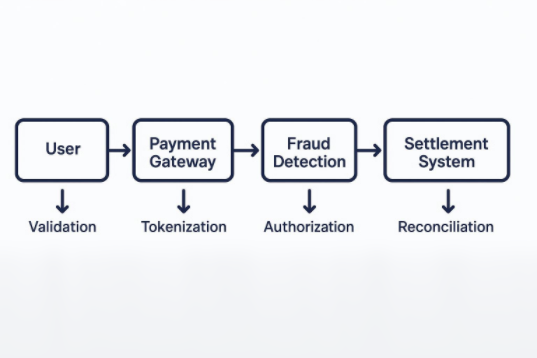
About the product/solution
The proposed solution is a comprehensive Payment Testing Framework and Platform designed to simulate, validate, and monitor complex financial transactions end-to-end.
How it works (user perspective)
From a QA or business perspective:
- Testers define payment scenarios (e.g., successful transaction, decline, timeout, fraud flag).
- The system simulates transactions across integrated payment layers.
- Results are validated in real-time with detailed logs and reconciliation checks.
- Edge cases and failure scenarios are automatically flagged and categorized.
Payment systems require more than traditional QA. Discover how specialized payment system testing helps organizations validate complex transaction flows, reduce production defects, strengthen compliance, and protect customer trust.
Main features
- End-to-end transaction simulation (authorization → settlement → reconciliation)
- Multi-provider testing (Visa, Mastercard, PSPs, banks)
- Fraud and risk scenario testing
- Data masking and tokenization validation
- API and UI layer coverage
- Automated regression suites for payment flows
- Real-time monitoring and reporting dashboards
Flexibility and reusability
- Configurable for multiple payment types (cards, wallets, BNPL, subscriptions)
- Reusable test scenarios across environments (QA, staging, production simulation)
- Extensible adapters for new payment providers
Why it’s better than generic testing frameworks
Generic frameworks (like Selenium or basic API testing tools) only validate functionality—they don’t understand:
- Financial transaction states
- Settlement dependencies
- Retry logic and idempotency
- Payment-specific error codes
This solution bridges that gap with domain-aware intelligence, making testing both realistic and reliable.
Technical architecture
Core components
- Backend:
- Microservices (Java / .NET / Node.js)
- Transaction orchestration engine
- Rule-based validation layer
- Frontend:
- React or Angular dashboard
- Scenario builder and reporting interface
- Data & Processing:
- Kafka or RabbitMQ for event streaming
- PostgreSQL / NoSQL database for transaction logs
- Testing & Simulation Engine:
- API mocking and stubbing for banks/payment gateways
- Synthetic data generation for card/token simulation
Integrations
- Payment gateways (Stripe, Adyen, PayPal)
- Banking APIs
- Fraud detection systems
- Logging tools (ELK stack)
Deployment
- Dockerized microservices
- Kubernetes-ready
- Deployable in cloud (Azure, AWS, GCP) or on-premises
Key technical challenges & solutions
| Challenge | Solution |
| Simulating real-world payment failures | Built advanced mocking and behavior-driven simulations |
| Ensuring data privacy | Implemented tokenization and masked test data |
| Handling asynchronous flows | Used event-driven architecture (Kafka) |
| Third-party unpredictability | Created controlled sandbox environments |
Integration and adaptability
This payment testing solution is designed to integrate seamlessly into enterprise ecosystems.
Where it can plug in
- CI/CD pipelines (Azure DevOps, Jenkins, GitHub Actions)
- QA automation frameworks
- Monitoring and observability stacks
Supported systems
- Payment gateways (Stripe, Adyen, Braintree)
- Banking services via Open Banking APIs
- ERP and financial systems
- CRM and support tools
Enterprise readiness
- Single Sign-On (SSO) support
- Role-Based Access Control (RBAC)
- Audit trails and reporting (critical for compliance)
Modular architecture
- Pluggable adapters for new payment providers
- Custom rule engines for business-specific validations
- Easily extendable for new payment methods
Benefits and outcomes
Organizations adopting this approach can expect:
- Reduced revenue leakage from failed transactions
- Faster release cycles with automated regression testing
- Improved compliance readiness (PCI DSS, PSD2)
- Higher customer trust and satisfaction
- Early detection of critical failures
Typical impact metrics
- 30–50% reduction in payment-related production defects
- 40% faster test execution cycles
- Significant reduction in manual validation efforts
- Improved transaction success rates
FAQ
Payment system testing is a specialized QA approach for validating digital payment processes from authorization through settlement and reconciliation. It covers functional behavior, integrations, security, transaction states, failures, and financial accuracy.
Payment systems involve banks, payment gateways, card networks, fraud systems, asynchronous processes, and regulatory requirements. Traditional testing tools can validate individual functions but often lack the domain awareness required to test the complete payment lifecycle.
Testing should cover successful and declined payments, timeouts, retries, duplicate transactions, refunds, fraud flags, authorization failures, settlement issues, reconciliation mismatches, and third-party service interruptions.
Yes. Automated regression suites can simulate payment scenarios, validate transaction states, check APIs and integrations, and identify failures throughout the payment lifecycle. Automation can also be integrated into CI/CD pipelines.
A specialized testing framework can validate controls such as data masking, tokenization, access management, and audit trails while supporting compliance requirements associated with standards and regulations such as PCI DSS and PSD2.
It can help reduce payment-related production defects, detect critical failures earlier, accelerate regression testing, reduce manual validation, improve compliance readiness, and ultimately provide more reliable payment experiences.
Now that you’ve read this, check out how we modernized a decade old platform for a client and made it AI-future ready
